
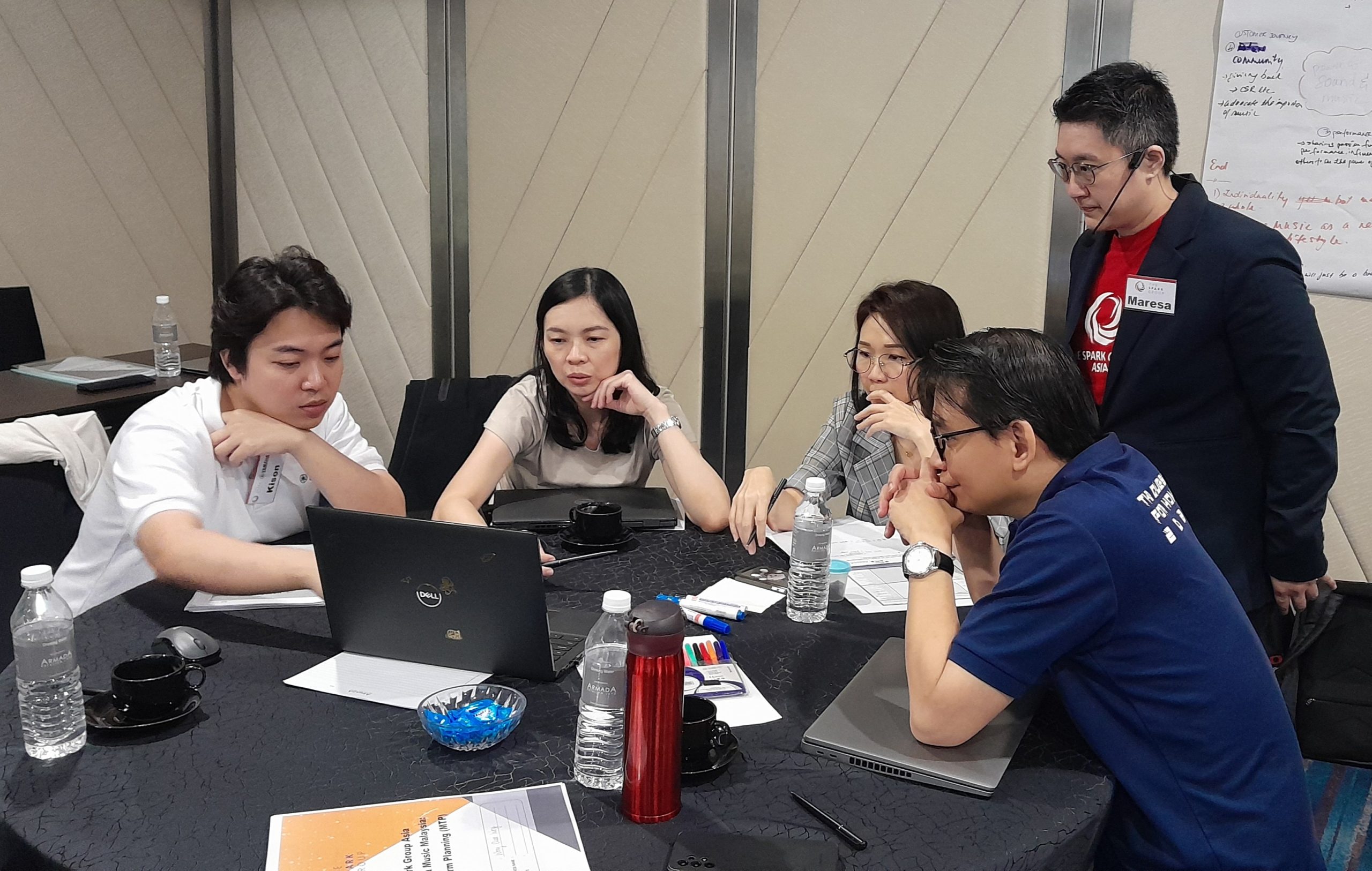
Your Teams are Busy. So Why does Execution Stall?
As an organisation scales, roles drift. People pick up work the strategy never asked of them, handovers pass through more hands, and your best people spend their energy on tasks that drain them. None of this shows on an organisation chart or a KPI dashboard. It shows up as:
Slow, Leaky Handovers
Silos between Departments
Strong Performers Running on Empty
The Solution
Execution Edge™: EEP plus Facilitation
The Execution Energy Profile (EEP™) Assessment asks every participant to describe the same work through three lenses, then compares them side by side. Execution Edge™ is the complete solution, pairing EEP with a two-day facilitated OD lab and a 180-day re-profile.
Motivation fitPREF vs CURRENT
Role fitROLE vs CURRENT
CURRENT is the baseline: how each person describes where their time and energy actually go today.
Built on the DOIC Framework
Four Kinds of Execution Energy. Every Role Needs a Different Mix.
EEP uses the DOIC framework. In each lens, a participant splits 100 points across four energies, so you see not just what someone does, but how much of their energy each kind of work takes.
D
Driver
Results, pace, getting things done
WHEN IT'S SHORT Decisions drift and deadlines slip.
O
Organizer
Structure, systems, accuracy
WHEN IT'S SHORT Handovers leak and rework creeps in.
I
Innovator
Change, ideas, the future
WHEN IT'S SHORT The business runs on yesterday's playbook.
C
Connector
People, alignment, collaboration
WHEN IT'S SHORT Departments drift into silos.
Try It: How One Profile Reads
Pick a sample role-holder, or adjust the points yourself, and watch the two fit scores and the quadrant update.
Client Services Manager
Points out of 100 in each lens
97%
Motivation fit
High alignment between preference and current role energy.
92%
Role fit
Strong alignment with role expectations.
Where this profile sits
Moves as you change the profile
MOTIVATION FIT
95%+Below
The Misalignment
THIS PROFILE
The Sweet Spot
THIS PROFILE
The Hazard
THIS PROFILE
Burnout Risk
THIS PROFILE
Below 95%95%+
ROLE FIT
The Sweet Spot. Both motivation and role expectations match energy placement well.
3Lenses per person
Current, preference and role, side by side
100Points per lens
Split across the four DOIC energies
2Fit scores
Motivation fit and role fit, each out of 100%
95%High-fit threshold
Used to place each person in a fit quadrant
What You Receive
One Profile, Three Levels of Insight
Organisation OD Report
The full diagnostic for your leadership team:
- Three enterprise signals that shape the OD agenda
- Department comparison, mandates and cultural friction
- Individual fit quadrants and upskilling priorities
- A phased 180-day OD roadmap
C-suite & HR only
Team Heatmap Pack
Every role-holder's current, preference and role shares on one page per department, with motivation and role fit alongside. Patterns that take months to spot show up at a glance.
- Department averages for the workshop room
- Named view for leaders' private review
Department level in the room
Team Heatmap Pack, sample data for 30 role-holders. Shaded cells are Strong (28 to 35) or Dominant (36+). Click a person to open their profile above, or click MOT or ROLE to sort. Dots mark fit below the 95% threshold.
The Fit Quadrant: Where Each Person Sits
MOTIVATION FIT
The Misalignment
HIGH MOTIVATION, LOWER ROLE FITEnergised, but pulling away from what the role needs. Clarify outcomes and channel strengths.
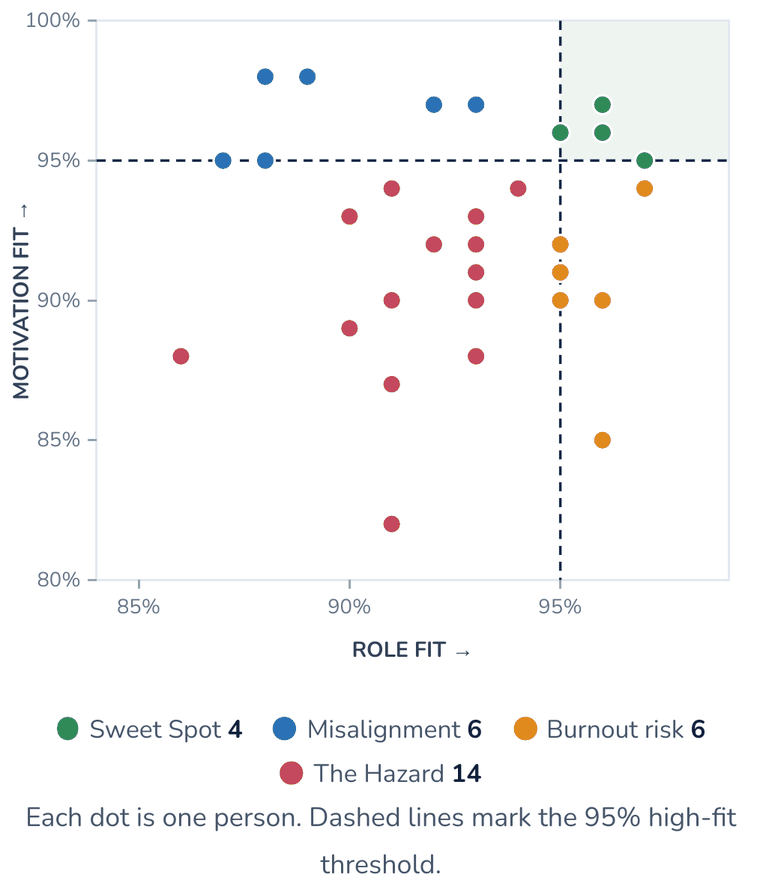
In the sample: 6 of 30 peopleThe Sweet Spot
BOTH FITS 95%+Protect the role design and use them as knowledge-sharing anchors.
In the sample: 4 of 30 peopleThe Hazard
BOTH FITS BELOW 95%Validate expectations, KPIs and workflow before any people decision.
In the sample: 14 of 30 peopleBurnout Risk
HIGH ROLE FIT, LOWER MOTIVATIONDoing what the role needs at a personal cost. Check workload and energy directly.
In the sample: 6 of 30 peopleROLE FIT
Quadrant labels are discussion signals, not diagnoses. They prompt a conversation that is validated with managers and direct evidence.
Illustrative Case: Fintech
Strong on the Surface. Misaligned Underneath.
The organisation: an approximately 120-person B2B fintech serving banks and insurers. After a run of enterprise wins, delivery slowed between Sales, Consulting and Customer Success. Leadership profiled 30 role-holders, from the CTO to analysts.
30
PROFILED
13
DEPARTMENTS
1 Average fits looked healthy. Few people were truly aligned.
Average motivation fit was 92% and role fit 93%. But only 4 of 30 cleared the 95% bar on both.
2 Roles asked for more structure. People wanted less.
Perceived ROLE carried +2.1 pts more Organizer energy than people spend today, while their PREFERENCE sat 2.3 pts lower. The gap was widest along the delivery chain.
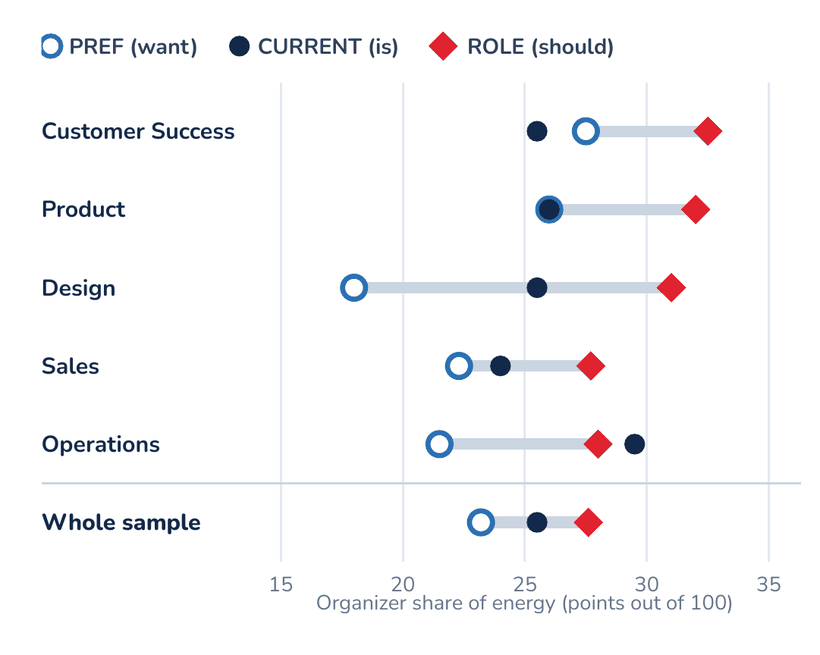
3 They wanted more connection.
Connector preference ran +2.2 pts above current, led by Engineering (29.2 wanted vs 24.6 today).
From signals to action: the three interventions the leadership team takes into the 2-day lab are set out below.
Illustrative case for a fintech organisation. It is not a client result. Departments with one or two people are directional only.
Illustrative Case: From Signals to Interventions
Three Interventions, Each Tested as a Bounded Trial.
On Day 2 of the lab, the leadership team turns the strongest signals into three interventions. Each starts as a bounded trial, so the company tests the change in one part of the business before committing to it company-wide.
What is a bounded trial?
A small, time-boxed change to how work gets done, with clear limits:
SCOPEOne team or one handover, not the whole company
OWNEROne named leader is accountable
DURATION30 to 60 days
MEASUREAgreed before the trial starts
DECISIONKeep, change or stop at the Day 90 review
Client handover standard
Sales to Consulting to Customer SuccessTHE SIGNALCustomer Success sees its role needing 32.5 points of Organizer energy against 25.5 today. Sales and Client Services show the same pull toward structure.
THE INTERVENTIONCo-design one handover standard across the three teams: a shared handover checklist and a joint kickoff for every new bank or insurer client.
THE BOUNDED TRIAL60 days, on all new client onboardings. Owner: Customer Success Lead. Measure: days from contract signed to client kickoff; issues escalated in the first 30 days.
Product and Design planning rhythm
Product and DesignTHE SIGNALDesign's role calls for 31 points of Organizer energy while designers prefer 18, a 13-point pull. Product shows a similar gap: 32 needed against 26 today.
THE INTERVENTIONA fortnightly joint planning session for Product and Design, with protected exploration blocks so structure doesn't crowd out creative work.
THE BOUNDED TRIALOne release cycle (6 to 8 weeks). Owner: Head of Product. Measure: designs handed to Engineering on the agreed date; designers' motivation fit at re-profile.
Engineering connection blocks
Engineering with Product and Customer SuccessTHE SIGNALEngineers want 29.2 points of Connector energy against 24.6 today, the strongest appetite for connection in the company.
THE INTERVENTIONA weekly 30-minute cross-team demo with Product and Customer Success, plus meeting-free focus mornings.
THE BOUNDED TRIAL8 weeks, across the Engineering team. Owner: Engineering Manager. Measure: focus hours protected per engineer; cross-team clarity in a short pulse check.
The Spark Group Asia Difference
Data Shows the Gap. Facilitation Turns It into Decisions.
Most diagnostics stop at the report. With Execution Edge™, the Execution Energy Profile (EEP™) Assessment report is where the work begins: two facilitated days in which your leaders read the system together and redesign how the work gets done.
ProfileWhere energy goes
FacilitateRead the system, safely
TrialWork that changes
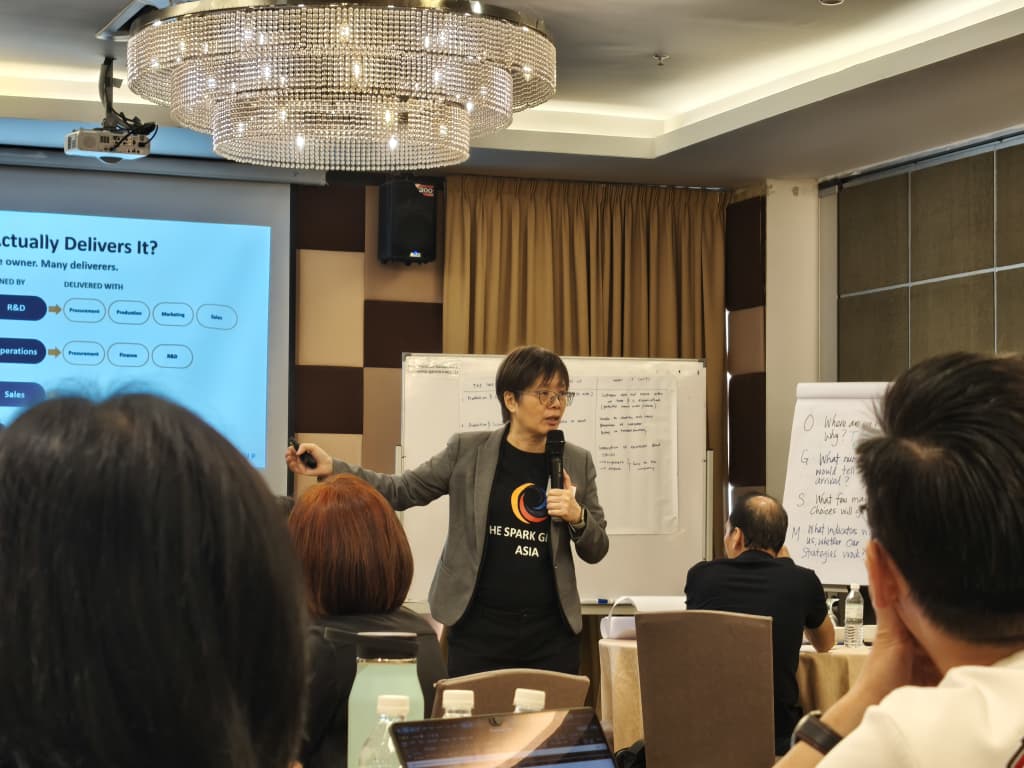
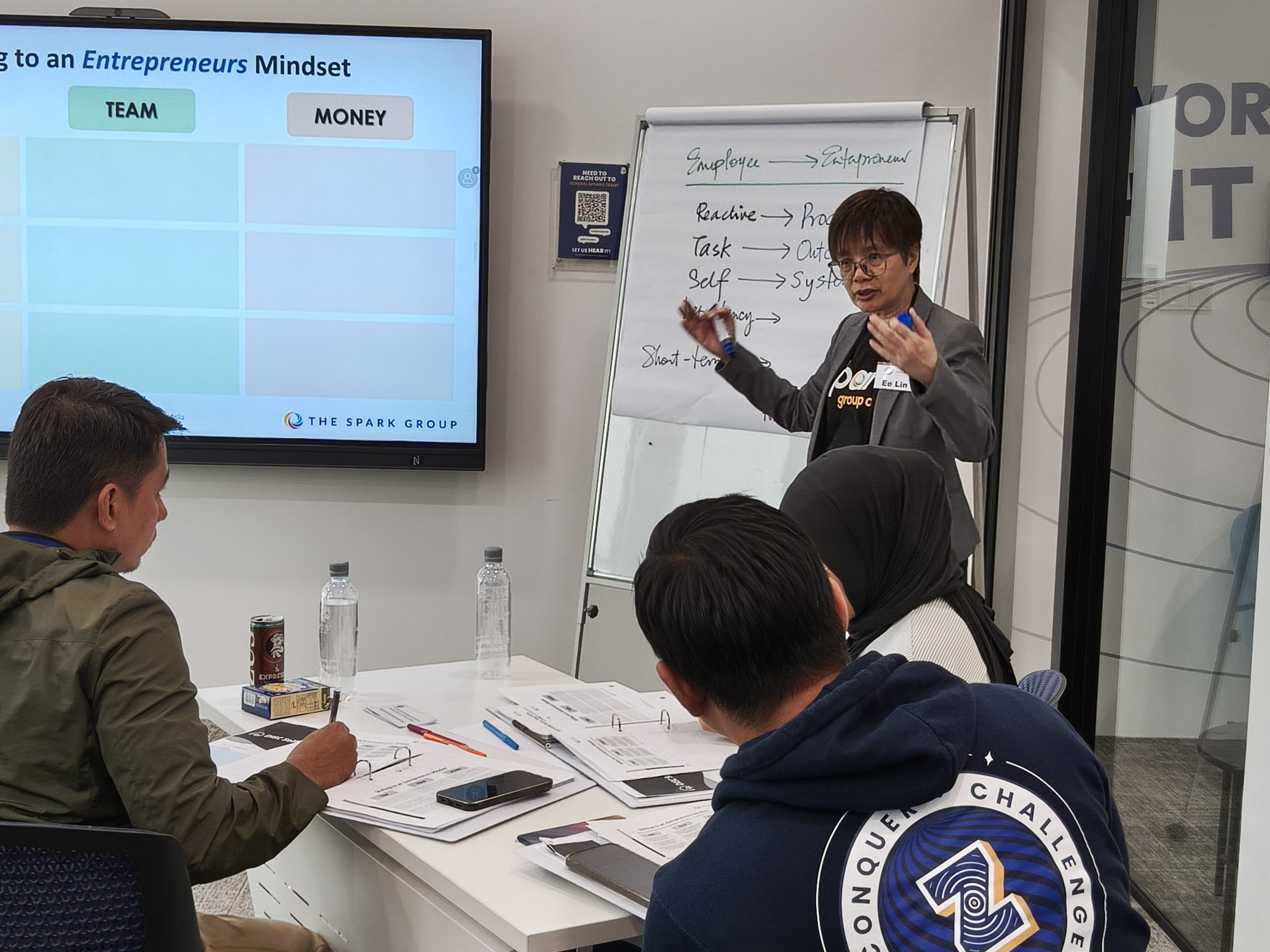
DAY 1
See the system
- Walk through the three enterprise signals as one leadership team
- Compare departments across current, preference and role
- Surface cultural friction using department-level data only
- Agree the priority signals worth acting on
Leadership team
Organisation OD Report
Agreed priority signals
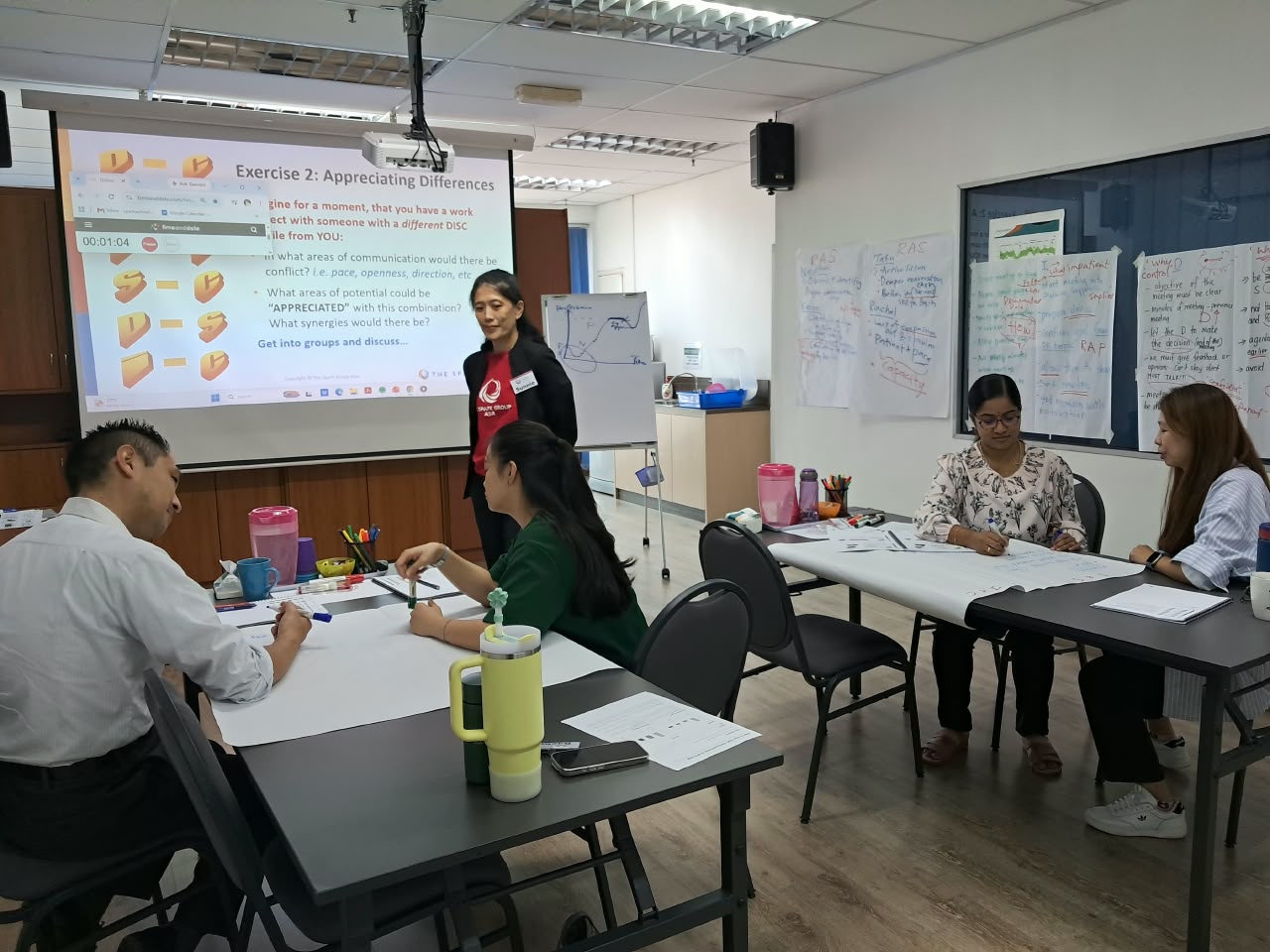
DAY 2
Redesign the work
- Set a clear OD mandate for each department
- Leaders-only, private review of fit quadrants
- Choose three bounded trials: small, time-boxed changes run in one team or handover, each with an owner and a success measure
- Build the phased 180-day OD roadmap
Leadership team
Heatmap Pack
Department mandates
3 bounded trials
180-day roadmap
Optional Add-ons
1:1 coaching debriefsPrivate sessions with an ICF-credentialed coach for individuals flagged for review.
Day-90 trial reviewA half-day session to review trial evidence and decide whether to keep, change or stop each trial.
2 days
Facilitated by HRD Corp-accredited, ICF-credentialed coaches
HRD CORP CLAIMABLE
Facilitated by HRD Corp-accredited, ICF-credentialed coaches
3 trials
Each limited to one team, 30 to 60 days, one owner and one measure
Each limited to one team, 30 to 60 days, one owner and one measure
180 days
A phased OD roadmap from validation to keep, change or stop
A phased OD roadmap from validation to keep, change or stop
How It Works
The Execution Edge™ journey: Six Steps from Profile to Proof
On Day 2 of the lab, the leadership team turns the strongest signals into three interventions. Each starts as a bounded trial, so the company tests the change in one part of the business before committing to it company-wide.
1
Scope
Agree the population: the whole organisation, one business unit or the leadership team. Confirm the sponsor.
2
Profile
Participants complete the online Execution Energy Profile (EEP™) Assessment while HR tracks completion.
Under 30 days. The timeline depends on how quickly participants complete. Deadlines must be respected.
3
Validate
The Spark Group Asia reviews the results and prepares the report before release.
4
Facilitate
The 2-day OD lab turns signals into mandates, trials and a roadmap.
5
Trial
Three bounded trials, each limited to one team or handover, run for 30 to 60 days with an owner and a measure.
6
Re-profile
At Day 180, re-profile and make an explicit keep, change or stop decision.
Data That Feels Safe
People share where their energy really goes when they trust the process.
-
1
Energy, not ability. DOIC describes self-reported role energy, not ability, personality or performance. There are no right or wrong answers, so people can say honestly what drains them.
-
2
Developmental, not evaluative. Your sponsor confirms in writing that EEP is never the sole basis for appraisal, pay, promotion or exit decisions.
-
3
Department level in the room. The workshop uses department averages only, never a colleague's current, preference or role scores.
Built-in Accountability
Not a One-Off Diagnostic. A 180-Day Execution Rhythm.
Work patterns shift as teams change, so EEP findings are valid for 180 days. Execution Edge™ builds trials and re-profiling into the program, so you can see whether the redesign really moved energy where the strategy needs it.
Option A: one cycle
One full 180-day cycle, from baseline to re-profile
- Profile + 2-day labEEPDay 0
- Validate signalsDay 30
- Trials runningDay 60
- Review trial evidenceDay 90
- Re-profile: keep, change or stopEEPDay 180
Option B: twice a year
Each re-profile becomes the next cycle's baseline
- Profile + 2-day labEEPMonth 0
- Trial reviewMonth 3
- Re-profile + lab refreshEEPMonth 6
- Trial reviewMonth 9
- Re-profile + year-end reviewEEPMonth 12
EEP profile and facilitated session Validation or trial review
Every CyclePROFILEThree lenses, same population, same framework
FACILITATEMandates and three bounded trials
TRIALOwners run trials and gather evidence
RE-PROFILECompare fits against the last cycle
Trials don't fadeOwners know results are reviewed at Day 90 and Day 180.
Gaps are trackedEach cycle shows whether fit is closing, by department.
Progress you can reportShow the board movement in data, not anecdotes.
Pairs Well With Ignite360™
Profile the Work.
Then the Leaders Who Lead It.
Execution Edge™ pairs well with Ignite360™ when leadership behaviour is part of the picture.
| Execution Edge™ | Ignite360™ | |
|---|---|---|
| Focus | The work | The leaders |
| Asks | Where does our energy go, and does it match what each role needs? | How do the people around our leaders experience them? |
| Whose view | Every role-holder, through three lenses | Self, superiors, peers and direct reports |
| Facilitation | 2-day OD lab, department mandates and 3 bounded trials | Coaching debriefs, team workshop or leadership offsite |
Use both when execution gaps and leadership behaviour are both in play. Leaders read both sets of data in one facilitated lab, and both are re-measured on the same twice-a-year rhythm.
Scope Options at a Glance
Choose the Scope that Fits Your Organisation
| Whole organisation | Business unit | Leadership team | |
|---|---|---|---|
| Decision maker | CEO or Managing Director | Head of the function, e.g. Head of Quality Assurance | CEO or Managing Director, with HR |
| Best for | Growing companies of roughly 50 to 300 people whose roles have outgrown the org chart | One function or BU of 30 to 150 people inside a larger organisation | Top 15 to 50 leaders after a merger, restructure or strategy shift |
| Who's profiled | All role-holders, every department | Everyone in the unit, plus key interfaces | Senior and middle leaders |
| Typical trigger | Slow handovers, silos, founder bottlenecks | Post-reorg friction, a new mandate | Integration, new operating model |
| Outcome | Enterprise signals, department mandates and a 180-day roadmap | Unit mandate, interface fixes and trials | Aligned leadership roles and operating rhythm |
Investment depends on the number of participants and the options chosen, and is set out in your tailored proposal.
Who It’s For
Who Execution Edge™ is For
Work patterns shift as teams change, so EEP findings are valid for 180 days. Execution Edge™ builds trials and re-profiling into the program, so you can see whether the redesign really moved energy where the strategy needs it.
- Group CEOs and business ownersWho want the whole organisation executing at the same pace.
- Managing Directors of growing companiesWhose roles have outgrown the org chart.
- Heads of business units or functionsLeading a unit through post-reorg friction or a new mandate.
- CEOs and HR leaders after a merger or restructureWho need aligned leadership roles and operating rhythm.
FAQ
Questions Leaders Ask Us
1. What is the Execution Energy Profile (EEP™) Assessment?
An online assessment built on the DOIC framework. Each participant splits 100 points across Driver, Organizer, Innovator and Connector energy, three times: for the work they do today (current), the work that motivates them (preference) and what they believe their role demands (role). Comparing the three shows where execution energy is out of step.
2. How long does the EEP take to complete?
The profiling stage can be completed in under 30 days. The exact timeline depends on how quickly participants complete their assessments, so completion deadlines must be respected. HR tracks completion throughout.
3. Is Execution Edge™ claimable under HRD Corp?
The 2-day facilitated OD lab is HRD Corp claimable. The EEP reports are not HRD Corp claimable.
4. Is this a personality test?
No. DOIC describes self-reported role energy: where people put their effort, what motivates them and what they believe their role requires. It does not measure ability, personality type or performance.
5. Will the results be used for appraisals or people decisions?
No. EEP is developmental, not evaluative. Your sponsor confirms in writing that EEP is never the sole basis for appraisal, pay, promotion or exit decisions.
6. Who sees individual results?
Individual results go to the C-suite and HR only. In the workshop room, teams see department averages, never a colleague’s scores.
7. What do labels like Burnout Risk mean?
They are discussion signals, not diagnoses. Each label opens a conversation that is always checked against direct evidence and validated with managers.
8. How is our data protected?
All individual data is handled under applicable privacy regulations, including the Personal Data Protection Act (PDPA).
9. What size of organisation is it for?
Whole-organisation scope suits growing companies of roughly 50 to 300 people. Business unit scope suits one function of 30 to 150 people inside a larger organisation. Leadership team scope covers the top 15 to 50 leaders.
10. Who runs the bounded trials?
Your own leaders. Each trial has one named owner from your organisation who is accountable for it and gathers the evidence. The Spark Group Asia facilitates the decisions in the lab and, with the Day-90 add-on, the trial review.
11. Why re-profile at Day 180?
Work patterns shift as teams change, so EEP findings are valid for 180 days. Re-profiling shows whether the redesign really moved energy where the strategy needs it, and gives you data to report to the board.
12. Who facilitates the OD lab?
HRD Corp-accredited, ICF-credentialed coaches from The Spark Group Asia.
13. How is it different from Ignite360™?
EEP profiles the work: where energy goes and whether roles are set up to execute. Ignite360™ profiles the leaders: how they are experienced by superiors, peers and direct reports. They pair well when leadership behaviour is part of the picture. See how they fit together.
14. How much does it cost?
Investment depends on the number of participants and the options chosen, and is set out in your tailored proposal.
Ready to See Where
Your People’s Energy Actually Goes?
Discuss the scope, format and cadence that suit your organisation.
Let's Design Your Execution Edge™ Program
We’re excited to hear from you! Please fill in the form, and we’ll be in touch shortly.