

The most common mistake organisations make? Promoting their best individual contributor into management; and assuming leadership will follow naturally.
It rarely does.
The skills that make a great engineer, salesperson, or analyst aren’t the skills that make a great manager. Yet most organisations offer little to no structured support for this critical transition. The result? New managers feel overwhelmed, their teams feel unsupported, and the business pays the price in turnover, disengagement, and missed performance.
Why First-Time Manager Development Is a Business Priority
Research consistently shows that managers account for at least 70% of the variance in employee engagement (Gallup). And yet, most people step into their first management role with no formal preparation; learning by doing, often at their team’s expense.
If your organisation promotes from within (which most do), then investing in first-time manager development isn’t a “nice to have.” It is a core retention and performance strategy.
Here are three practical ways HR and L&D teams can close the new-manager readiness gap.
1. Help New Managers Understand the Fundamental Mindset Shift
The biggest transition isn’t about skills. It’s about identity.
As individual contributors (ICs), people are rewarded for what they produce. As managers, they are rewarded for what their team produces. That’s a profound shift; and most new managers don’t realise they need to make it.
Left unaddressed, this gap shows up as:
- Micromanagement (taking back tasks instead of delegating them)
- Underperformance conversations avoided for too long
- Burnout from trying to do their old job and their new one simultaneously
- Teams that feel unsupported or undervalued
What HR can do:
Run a dedicated onboarding session for all newly promoted managers; before they start in the role; that explicitly names this shift. Don’t assume they’ve figured it out. Name it, explain it, and give them language to process it.
Use questions like:
- “What does winning look like in your new role, compared to your old one?”
- “What’s the hardest thing you’ll need to stop doing?”
- “Who on your team could you invest in this week?”
The goal is to move them from “How do I do the work?” to “How do I enable others to do the work?”
2. Give Them Practical, Actionable Tools
Big frameworks don’t help when a manager is stressed at 4pm on a Wednesday.
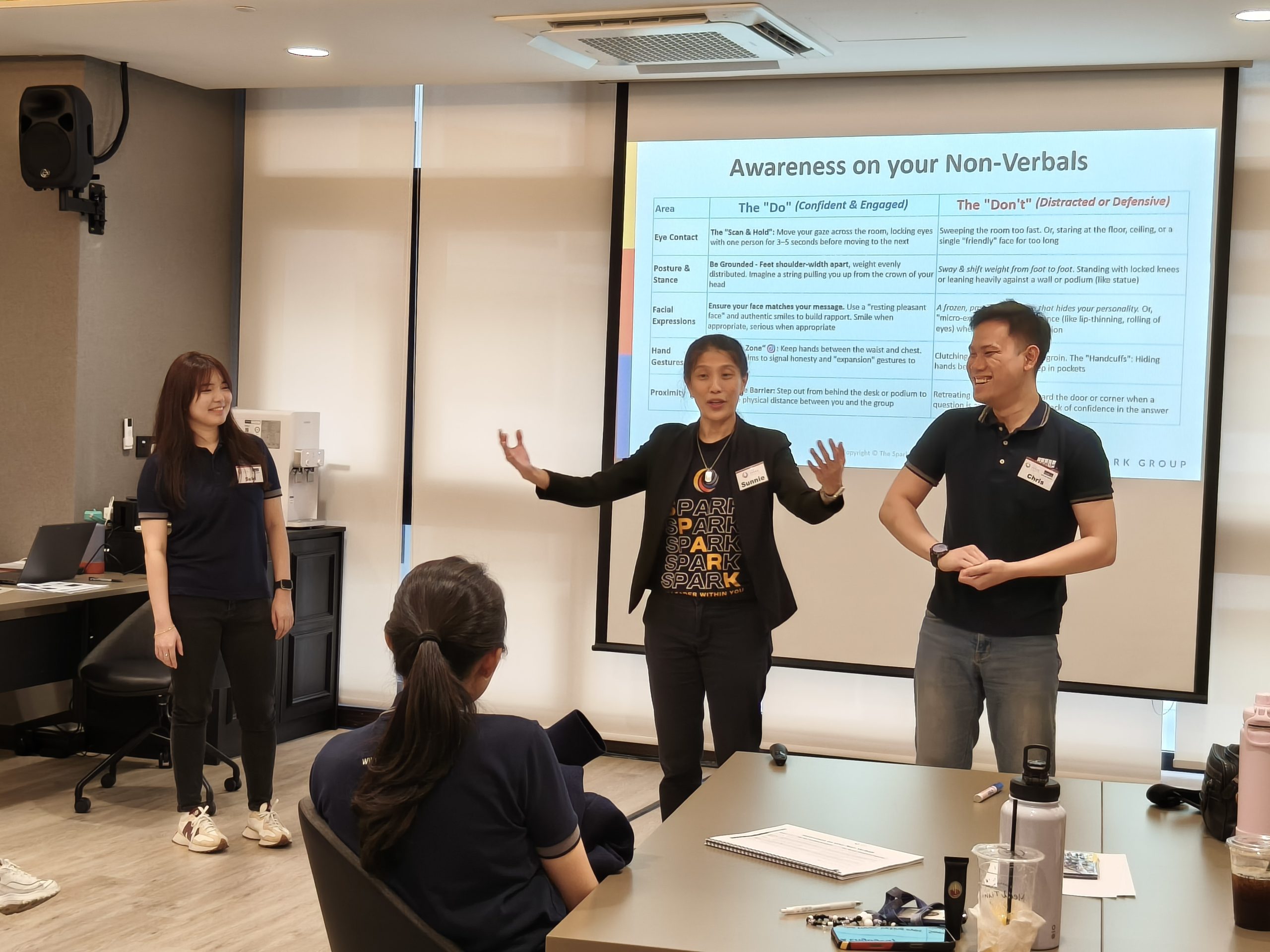
New managers don’t need a 300-slide deck on leadership theory. They need immediately applicable tools they can pick up, use in the moment, and build confidence over time.
That means:
- A simple 1-on-1 meeting template they can use from week one
- A straightforward framework for giving feedback (without the conversation turning awkward)
- A guide for handling underperformance early; before it becomes a crisis
- Scripts for common difficult conversations: performance issues, conflict, missed expectations
What HR can do:
Build a simple “New Manager Toolkit”, a short, curated set of resources covering the most common leadership moments. Make it accessible, practical, and short enough to actually use.
Better yet: Enrol your new managers in our signature leadership programs that are also HRDC claimable.
Recommended Programmes from The Spark Group Asia
Designed for managers who are ready to lead with clarity, confidence, and purpose. LWI focuses on the practical leadership behaviours that drive real team performance; not theory for its own sake.
2. Effective Leadership & Communication Mastery (ELCM)
Equips managers with the communication skills they need most: how to influence, how to give feedback, how to have tough conversations, and how to build trust quickly. Ideal for first-time managers navigating the complexity of leading people for the first time.
Both programs are built around the realities of leadership in the modern workplace, practical, participant-centred, and immediately applicable from day one.
3. Keep the Learning Alive After the Program Ends
Here’s the problem with most leadership training: people forget up to 70% of new information within 24 hours (Ebbinghaus Forgetting Curve).

A one-day or two-day training can create a powerful shift in awareness. But awareness alone doesn’t build new habits. For behaviour to actually change, learning has to be reinforced over time; in small, consistent doses, applied in real situations.
Without reinforcement, organisations invest in training and see little lasting change. Managers revert to old defaults. Teams don’t see improvement. And HR is left wondering why the program “didn’t work.”
The answer isn’t better training. It’s better to follow-through.
The Learning Reinforcement System (LRS) by The Spark Group Asia
The Learning Reinforcement System (LRS) is designed specifically to solve this problem.
Rather than letting learning fade after a training ends, LRS delivers structured, spaced reinforcement content over weeks, embedding key behaviours into daily leadership practice. It’s the bridge between “I learned something” and “I actually do it now.”
For HR teams investing in manager development, LRS is the missing piece that makes the rest of the investment stick.
The best organisations don’t just promote great individual contributors. They build great managers; deliberately, systematically, and with the right support at every stage.
If your organisation is ready to invest in first-time manager development that actually creates lasting change, The Spark Group Asia offers the programmes and reinforcement infrastructure to make it happen.
Explore our programs: